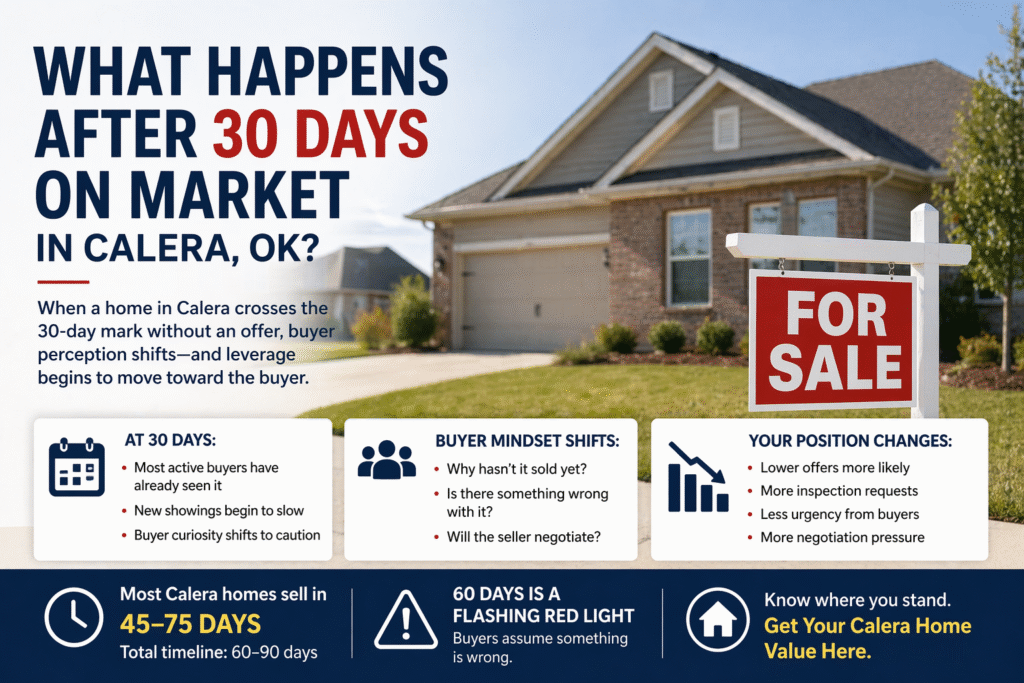
When a home in Calera, OK crosses the 30-day mark without an offer, buyer perception shifts—and leverage begins to move toward the buyer. While homes can still sell after this point, it often leads to longer timelines and more pressure on your bottom line.
Why the 30-Day Mark Matters in Calera
In Calera’s current market, most homes that are positioned correctly generate their strongest activity in the first two to three weeks.
By the time a listing reaches 30 days:
- Most active buyers have already seen it
- New showings begin to slow
- Buyer curiosity shifts to caution
In other words, the market has seen your home and decided not to act yet—that’s the part you can’t ignore.
What Buyers Start Thinking After 30 Days
Once a home crosses 30 days on market, buyers begin asking different questions.
Instead of:
- “Should we go see it?”
They start asking:
- “Why hasn’t it sold yet?”
- “Is there something wrong with it?”
- “Will the seller negotiate?”
In a market like Calera—where buyers are typically primary residence buyers and more price-sensitive—this shift happens quickly.
How Your Position Changes at Day 30
Crossing the 30-day mark doesn’t just affect perception—it changes negotiation dynamics.
At this stage:
- Buyers are more likely to submit lower offers
- Inspection requests tend to increase
- Sellers lose leverage, and buyers feel less urgency than they did in week one
- Negotiation becomes more aggressive
Homes that generate early activity tend to maintain stronger positioning, while those that don’t begin to feel resistance from the market.
👉 How to Price Your Home in Calera, OK in 2026
How This Fits Into the Overall Timeline
In 2026, most Calera homes that are priced correctly fall within a 45–75 day on-market window, with a 60–90 day total timeline from listing to closing.
👉 How Long Does It Take to Sell a House in Calera, OK in 2026
The 30-day mark sits in the middle of that decision window. It’s where a listing either stays on track toward a contract or starts to slide into “why hasn’t it sold?” territory.
How Calera Compares to Durant at 30 Days
Durant generally moves faster due to higher demand and inventory.
In Calera:
- Buyer activity is steady but more selective
- Pricing sensitivity is higher
- Momentum matters more
Because of this, crossing 30 days in Calera has a more noticeable impact on buyer perception than in larger, faster-moving markets.
What Happens If a Home Reaches 60 Days?
If 30 days is a yellow light, 60 days is a flashing red light.
At that point:
- Buyers often assume something is wrong
- Showings tend to slow further
- Price expectations begin to shift downward
This is where hesitation turns into skepticism, and the path to a contract becomes more difficult.
What to Do Once You Cross 30 Days
At this point, the focus shifts from waiting to understanding how buyers are reacting.
Rather than guessing, the next step is to look at what the market is telling you and respond accordingly.
For a breakdown of how sellers typically adjust at this stage:
👉 Calera Home Not Selling? Three Strategic Price Moves That Get Contracts in a Slower Market
Warning Signs Your Calera Home Is Losing Momentum
- Showings slow significantly after the first few weeks
- Buyers view the home but don’t return or make offers
- Feedback becomes more critical or price-focused
- Comparable homes go under contract while yours stays active
- Online traffic does not convert into in-person showings
If two or more of these apply, it’s time for a local pricing and strategy conversation before your home keeps sitting.
👉 How to Avoid Sitting on the Market in Calera, OK in 2026
FAQ: Selling a Home in Calera, OK
Is now a good time to sell in Calera, OK?
Yes—Calera continues to see steady buyer demand, especially in the $200,000–$240,000 range where most activity occurs. Homes that are positioned correctly are still selling within the 45–75 day window. If your home is getting consistent showings early, you are typically aligned with current market conditions.
What does 30 days on market really mean?
Thirty days on market is when buyer perception begins to shift. It signals that your home has been seen but not acted on, which often leads buyers to question value or condition. It’s less about time itself and more about how buyers interpret that time.
Can a home still sell after 30 days?
Yes, many homes sell after 30 days, especially in a steady market like Calera. However, they often sell under different conditions, including longer timelines or stronger negotiation from buyers. Understanding what has changed is key to moving forward effectively.
Do homes in Calera sell slower than Durant?
Durant typically moves faster due to higher demand and a larger pool of buyers. Calera moves at a steadier pace and is more price-sensitive, meaning well-positioned homes sell on time, while others may take longer to generate the same level of activity.
What happens if a home sits past 60 days?
At 60 days, buyers often assume something is wrong with the property. Showings tend to drop, and offers—if they come—are usually more aggressive. This stage requires more noticeable adjustments to regain interest and move toward a successful sale.
Final Thoughts
In Calera, the 30-day mark isn’t a failure point—it’s a signal.
It tells you how the market is responding and whether your current position is working. Sellers who recognize this shift early can stay on track, while those who ignore it often move into longer timelines and tougher negotiations.
👉 Find Out What Your Calera Home Will Actually Sell For in This Market
Jason Hightower
Broker / Owner, American Dream Realty
📞 580-564-6583
📧 TexomaExpert@gmail.com