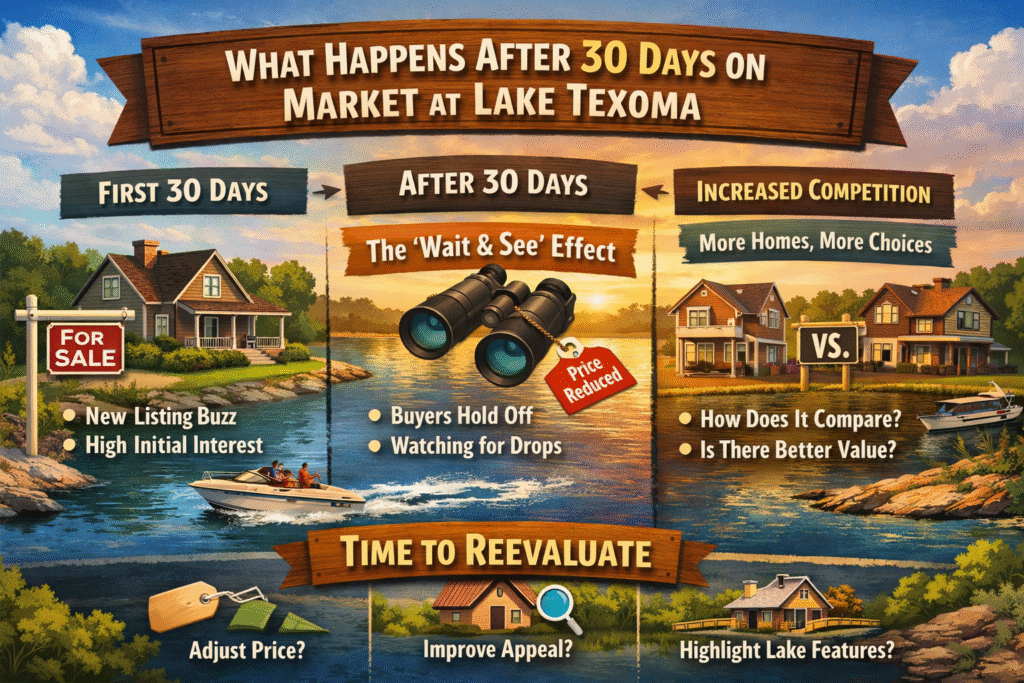
When a Lake Texoma property reaches 30 days on market without strong activity, it usually signals a shift — not just in time, but in how buyers begin to perceive the home.
In my experience working with lake property owners around Lake Texoma, the first few weeks of a listing are when the strongest interest typically occurs. If that window passes without meaningful traction, buyer behavior begins to change.
If you’re currently on the market or getting ready to list, understanding what happens at this stage can help you decide whether to stay the course or adjust.
If you’re still early in the process and want a full breakdown of how timelines work at the lake, you can read:
👉 How Long Does It Take to Sell a Lake Texoma Home in 2026
Why the First 30 Days Matter at Lake Texoma
Lake Texoma buyers tend to move quickly when they see a property that fits what they are looking for.
Many are:
- Weekend buyers from the Dallas–Fort Worth area
- Second-home shoppers planning future lake use
- Buyers comparing multiple shoreline areas at once
Because of this, well-positioned homes often generate the most interest early.
When a home reaches the 30-day mark, it typically means one of two things:
- Buyers have seen it — and passed
- The home is being compared unfavorably to other available options
How Buyer Perception Changes After 30 Days
Once a property has been on the market for about a month, buyers begin to interpret that time as a signal.
They may assume:
- The home is priced above comparable properties
- There are condition or location concerns
- The seller may be open to negotiating
This shift is subtle, but it changes how buyers approach the property.
Instead of urgency, buyers begin to show patience.
Instead of competing, they begin to wait.
The “Wait and See” Effect
At Lake Texoma, many buyers are not under immediate pressure to purchase.
Because they are often:
- Second-home buyers
- Lifestyle buyers
- Investors evaluating multiple options
They are comfortable waiting.
After 30 days on market, these buyers often:
- Save the listing
- Monitor for price reductions
- Compare it against new inventory
This becomes even more noticeable during peak listing seasons, when new inventory hits the market and gives buyers more choices. Older listings can quickly lose attention if they are not positioned correctly.
This creates a “wait and see” effect, where activity slows and offers become less aggressive.
How Competition Becomes a Bigger Factor
Once a listing moves past the early window, it is no longer competing as a “new” property.
Instead, it becomes part of the existing inventory pool.
At that point, buyers begin asking:
- Why hasn’t this home sold?
- How does it compare to newer listings?
- Is there a better value available?
As new listings hit the market — especially during spring and summer — they often draw the most attention first. That can push older listings further down the priority list unless something changes.
What This Means for Sellers
Reaching 30 days on market is not a failure — but it is a decision point.
At this stage, sellers typically need to evaluate:
- Current pricing relative to competition
- Property presentation
- Buyer feedback from showings
- Overall positioning in the market
If your home hasn’t yet reached 30 days and you want to position it correctly from the outset, the next step is making sure your strategy is aligned before going live.
Get a Clear Picture of Your Position in Today’s Market
If your property is approaching or has passed the 30-day mark, one of the most important steps is understanding how it compares to current inventory.
This helps identify whether buyers are seeing your home as a strong option at its current price, or whether competing listings are shaping their expectations differently.
What Usually Needs to Change
In most cases, listings that sit past 30 days require some form of adjustment.
That could include:
- Pricing repositioning
- Improved marketing or photography
- Highlighting key lake features more clearly
- Addressing condition or accessibility concerns
Around Lake Texoma, that may also mean clearly emphasizing things like marina access, proximity to the water, cove protection, or how easily buyers can use the property for weekend living.
For a more complete breakdown of how pricing and positioning work together in today’s market, you can read this guide on 👉how to price your Lake Texoma home in 2026:
Avoiding This Situation in the First Place
Most listings that reach the 30-day mark do so because of decisions made before going live.
The good news is that many of these issues can be prevented with the right strategy upfront.
f you’re still in the planning stage and want to prevent your home from stalling altogether, you can read this guide on how to avoid sitting on the market at Lake Texoma in 2026:
👉 How to Avoid Sitting on the Market at Lake Texoma in 2026
FAQ: Listings Sitting on the Market at Lake Texoma
Is 30 days on market bad for a Lake Texoma home?
Not necessarily, but it is a signal that buyers are not responding as strongly as expected. It usually means adjustments may be needed.
Why do buyers hesitate after a home has been on the market?
Buyers often assume there is a reason the home has not sold, which can make them more cautious and less likely to act quickly.
Should I lower my price after 30 days?
Not always immediately, but it is important to evaluate how your home compares to competing listings. Pricing is often a key factor.
Do Lake Texoma homes take longer to sell than in-town homes?
They can, because they appeal to a more specific buyer pool. However, well-positioned homes still generate strong early interest.
Do lake homes at Texoma take longer to recover than homes in Durant or Kingston?
In many cases, yes. Lake buyers tend to be more patient and less time-sensitive, which means listings that lose early momentum can take longer to regain attention compared to traditional residential markets.
Is now a good time to sell at Lake Texoma?
Market conditions vary, but well-prepared and properly positioned homes continue to attract serious buyers — especially those planning for future lake use.
Final Thoughts
Reaching 30 days on market changes how buyers see your property — but it also gives you an opportunity to adjust your strategy.
In my experience working with Lake Texoma sellers, the homes that ultimately succeed are the ones that respond to the market rather than resist it.
If you want to see where your property stands in today’s market:
Jason Hightower
Broker / Owner, American Dream Realty
📞 580-564-6583
📧 TexomaExpert@gmail.com